Justify the worst-case marker of a shared facility in hours — not weeks
Cross-contamination risk assessment rethought: CovaSolv cleanability × CovaTox hazard surfaces the worst-case marker of a multi-product facility in hours instead of weeks. Why it is the combination, not a single axis — and why carbamazepine wins on the example roster, ahead of methotrexate and ethinylestradiol.
Oliver Kraft
CovaSyn
Key takeaways
- In a multi-product facility every changeover needs a cross-contamination risk assessment (CCRA) — classically weeks of tox literature review plus solubility lab work.
- CovaSolv (cleanability) × CovaTox (hazard) surfaces the worst-case marker in hours.
- The point: the worst case is not the most toxic alone and not the least soluble alone — it is the combination.
- On the example roster (11 APIs): carbamazepine as the worst-case marker, ahead of methotrexate and ethinylestradiol.
- Honest: a prioritization tool, not a validation replacement — the formal PDE stays with the toxicologist, genotoxicity is assessed separately.
The ritual of every multi-product facility
Anyone manufacturing multiple products on shared equipment knows it: before every changeover a cross-contamination risk assessment must show which compound represents the "worst case" for cleaning validation — the marker compound the cleaning is designed and verified against. Classically that means weeks of toxicological literature review plus solubility measurements in the lab, for every possible changeover combination.
We show on an example roster of 11 APIs how this question can be prepared in hours with two CovaSyn suites: CovaSolv delivers cleanability, CovaTox the hazard — the combination yields the worst case. Every number is a prediction, meant to focus validation, not replace it.
Step 1 — Cleanability: what is hard to clean off?
Residue that does not dissolve in the cleaning medium is hard to remove. CovaSolv predicts each API's solubility in warm cleaning water (50 °C). Five compounds sit below 1 g/L — methotrexate (0.13), carbamazepine (0.17), ibuprofen (0.20), naproxen (0.21) and ethinylestradiol (0.30 g/L) — and are the cleaning-process problem children. Caffeine, paracetamol or benzoic acid (9 to 43 g/L) wash off easily.
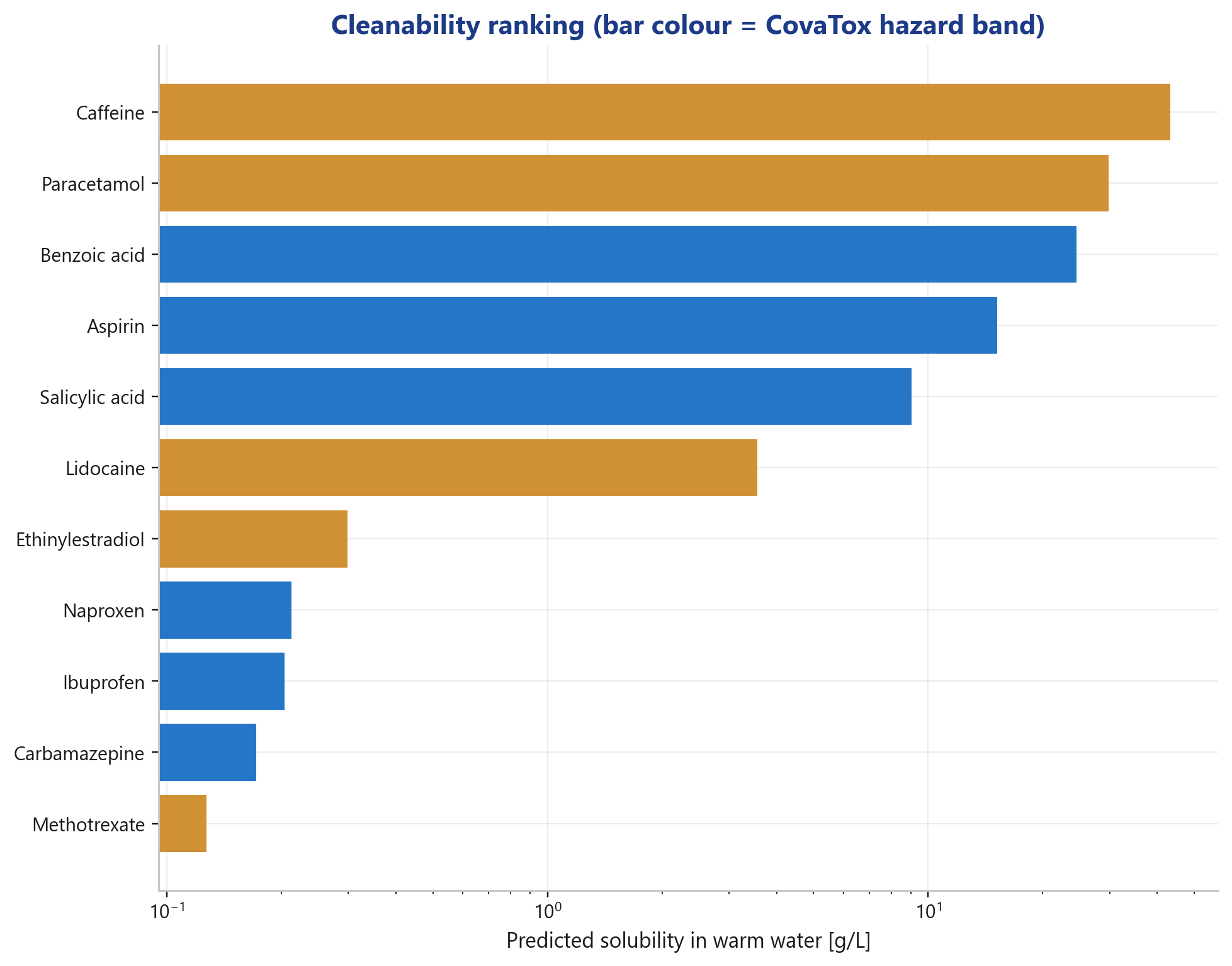
A detail that matters in practice: cleanability depends on the cleaning medium. The same screen can be run across multiple media (water, warm water, water/ethanol) — warm water is a conservative, well-comparable baseline here.
Step 2 — Hazard: how bad would a carryover be?
Hard to dissolve alone is not enough — what matters is how dangerous a residual carryover would be. CovaTox delivers a relative hazard score per API across organ and ADMET endpoints plus structural alerts. The highest in the roster: ethinylestradiol (3.60) and carbamazepine (3.32).
An honest aside that belongs here: for several of these drugs the model flagged the genotoxicity and carcinogenicity endpoints as out of the applicability domain — it tells you itself when it cannot reliably classify. That is by design: a model that knows its limits. The hazard score then leans on the reliably covered endpoints; the genotoxic potential is assessed separately.
Step 3 — The risk matrix: cleanability × hazard
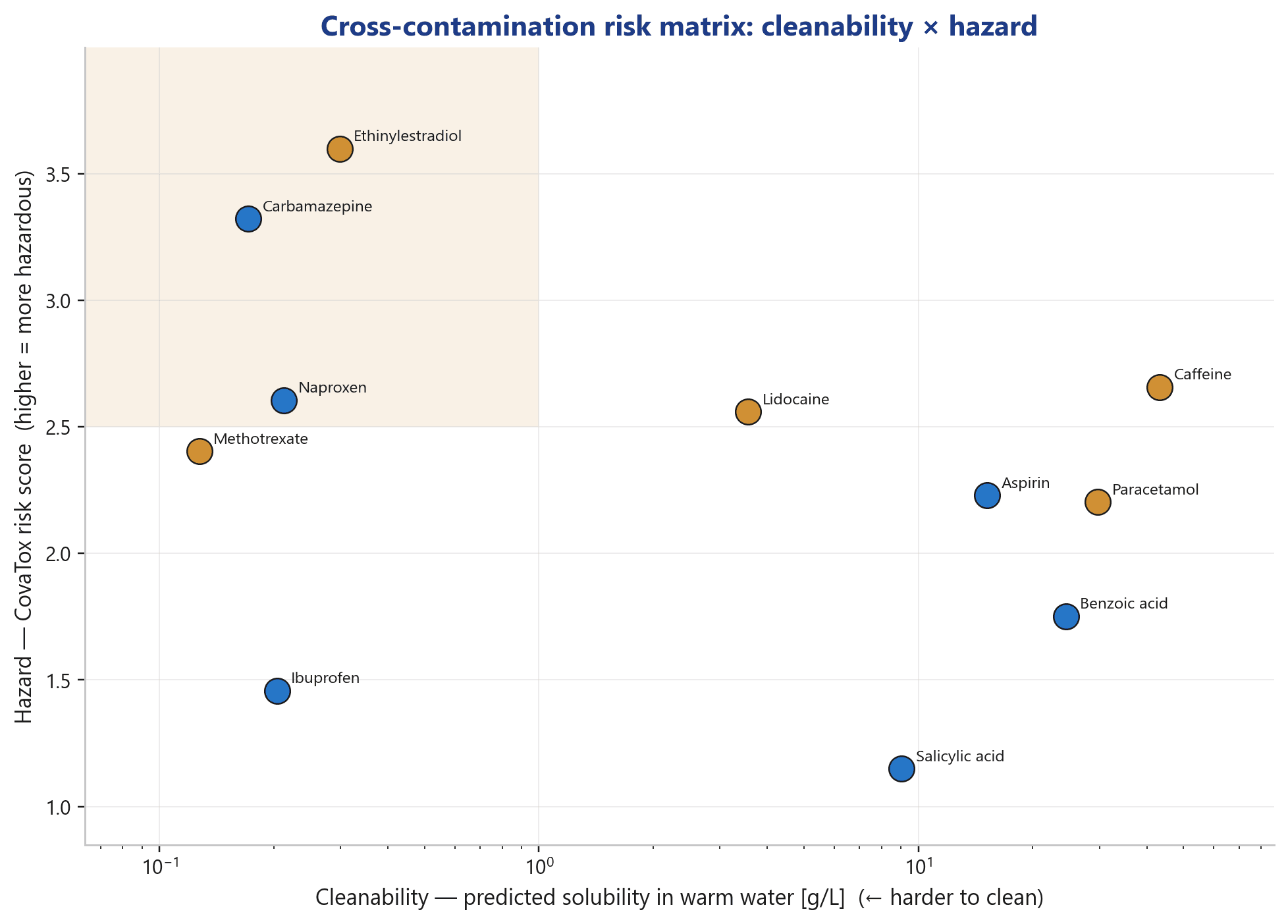
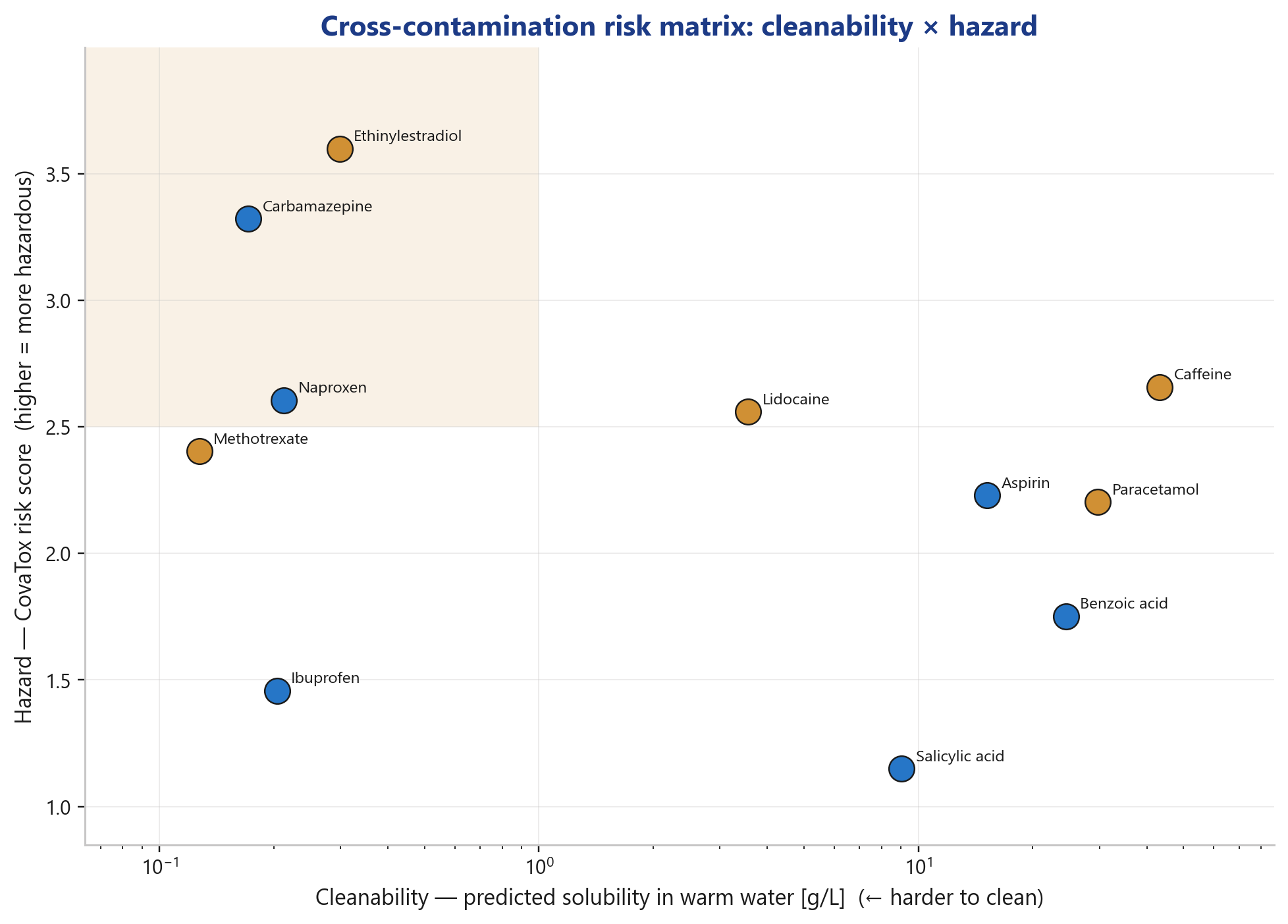
Only the combination makes the worst case visible. Plotting cleanability (x-axis, left = harder to clean) against hazard (y-axis), the critical region sits in the top-left: hard to clean and hazardous. That is where carbamazepine and ethinylestradiol sit.
The instructive part is what does not sit there: highly potent but easily soluble compounds like caffeine and paracetamol sit harmless in the top-right — they carry hazard, but they wash off. And the least soluble molecule alone (methotrexate) is not automatically the worst case if its hazard is lower. The worst case is the intersection, not a single axis. That two-dimensionality is exactly the point a pure tox table or a pure solubility list misses.
The result — a defensible worst-case selection
From the combined score the worst-case marker falls out: carbamazepine (changeover risk 0.66), ahead of methotrexate (0.51) and ethinylestradiol (0.43). Carbamazepine does not win because it is the most toxic (that is ethinylestradiol) or the least soluble (that is methotrexate), but because it combines both sufficiently.
The key values per API in the screening:
- Carbamazepine — warm-water solubility 0.171 g/L · hazard score 3.32 · changeover risk 0.66 (worst case)
- Methotrexate — 0.127 g/L · 2.40 · 0.51
- Ethinylestradiol — 0.298 g/L · 3.60 · 0.43
- Naproxen — 0.213 g/L · 2.60 · 0.35
- Ibuprofen — 0.204 g/L · 1.46 · 0.08
- Lidocaine — 3.558 g/L · 2.56 · 0.02
- Aspirin / paracetamol / caffeine / salicylic acid / benzoic acid — 9 to 43 g/L · low bands · ≈ 0.00
The product-pair heatmap additionally shows that under equal batch sizes the source products drive the risk: campaigns following carbamazepine, methotrexate or ethinylestradiol deserve the most cleaning attention.
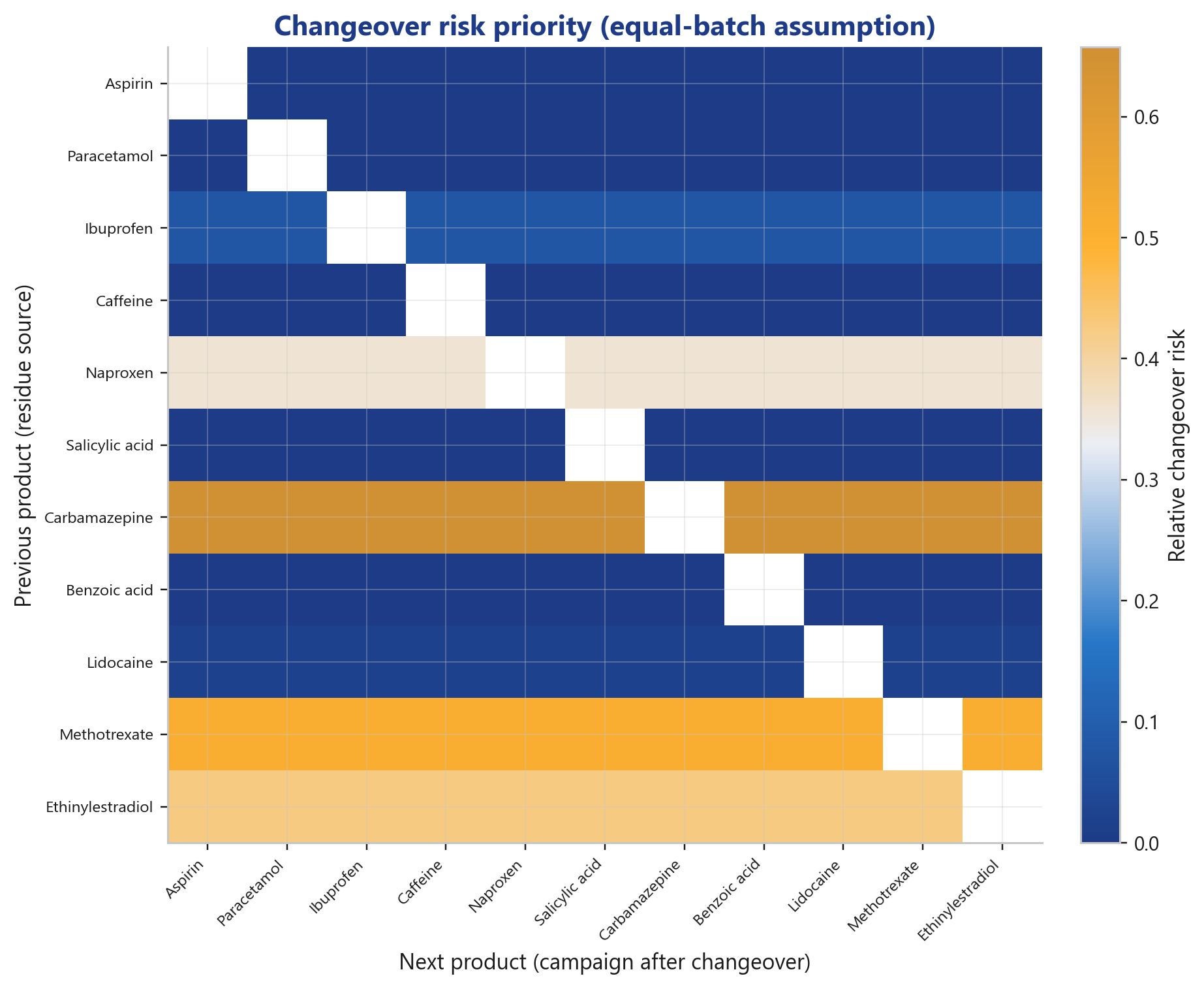
Instead of weeks of review, a justified worst-case selection plus risk matrix is on the table in hours — lab validation then concentrates on the few critical transitions.
Honestly placed (GMP)
All inputs are model predictions: CovaSolv delivers apparent solubility, CovaTox a relative hazard score, not a PDE/ADE. This screen prioritizes cleaning validation and justifies a worst-case marker — it does not replace it. For several drugs the genotoxicity (Ames/ICH M7) and carcinogenicity endpoints were flagged out of domain; the genotoxic potential must therefore be assessed separately. The formal health-based exposure limit (PDE/ADE) is set by a qualified toxicologist; a quantitative MACO needs the facility's real batch sizes and daily doses; analytical method validation remains a GMP requirement.
Try it yourself
You can run the same screen for your own product roster — cleanability and hazard per API, combined into the risk matrix, directly in the agent. On the free tier with 100 credits per week, no credit card. → See CovaSyn MCP
FAQ
What is a cross-contamination risk assessment (CCRA)?
The assessment of the risk that residues of one product carry over into a following one in a multi-product facility. It justifies a worst-case marker compound against which cleaning is designed and validated.
How do you determine the worst case in cleaning validation?
Not via a single property, but via the combination of poor cleanability (low solubility in the cleaning medium) and the hazard of a carryover (toxicological potency). A compound that is only one of the two is rarely the worst case.
Why isn't the most toxic compound automatically the worst case?
Because a highly potent but easily soluble compound is largely removed during cleaning. Only the combination of potency and poor cleanability creates the relevant carryover risk.
Does this screen replace cleaning validation or the PDE?
No. It prioritizes and justifies the worst-case selection. The formal health-based exposure limit (PDE/ADE) is set by a qualified toxicologist, the quantitative MACO needs real batch sizes and doses, and analytical method validation remains a GMP requirement.
What is MACO?
Maximum Allowable Carryover — the maximum permissible amount of a product carried into the next one, derived from the health-based exposure limit plus batch sizes and daily doses. The screen shown here prioritizes the transitions; the quantitative MACO follows with the facility data.
Methodology and data
Roster: 11 APIs (9 standard + methotrexate + ethinylestradiol for two hazard mechanisms). Cleanability: CovaSolv prediction of apparent solubility in warm water (50 °C). Hazard: CovaTox relative score across organ/ADMET endpoints + structural alerts (no PDE/ADE; genotox/carcinogen endpoints partially out of domain, to be assessed separately). Changeover risk: relative composite of hazard × cleaning difficulty under equal-batch assumption. All values are predictions for prioritization, not validation results. Data snapshot: 2026-05-22.
CovaSyn MCP
Scientific tools in your AI workflow.
130+ functions for pharma, biotech and chemistry. Free tier instantly active.