ICH M7 automated: mutagenicity triage in seconds — a Losartan worked example
ICH M7 requires two (Q)SAR methods per impurity. On a Losartan worked example: 10 impurities classified in seconds, 5 probable mutagens identified — including the well-known azido impurity (AZBT). How CovaTox covers both methods in one call, and where the limits are.
Oliver Kraft
CovaSyn
Key takeaways
- ICH M7 requires two complementary (Q)SAR methods for every actual and potential impurity — one rule-based (structural alerts) and one statistical.
- CovaTox runs both at once and classifies into ICH M7 classes 1 through 5.
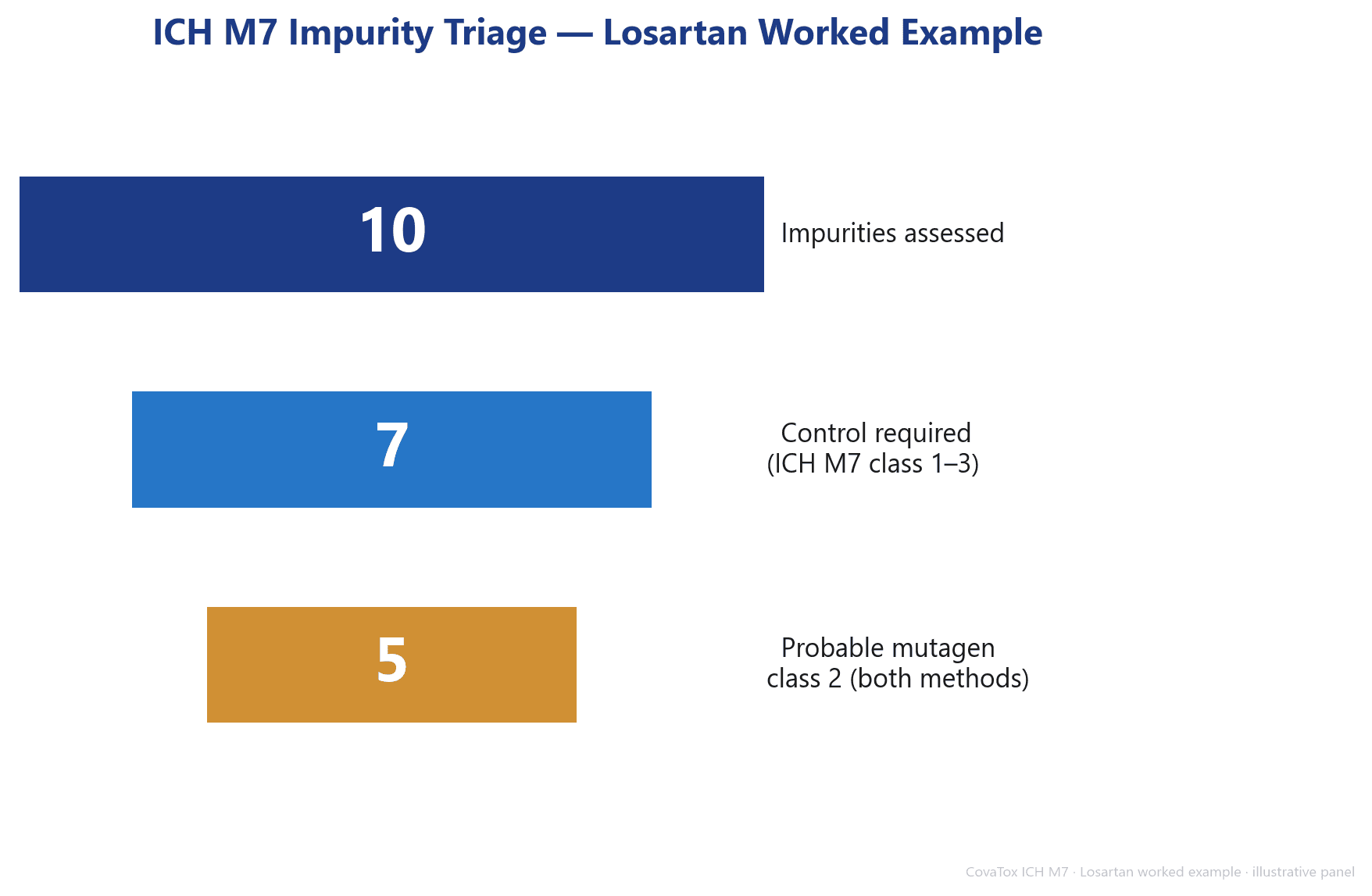
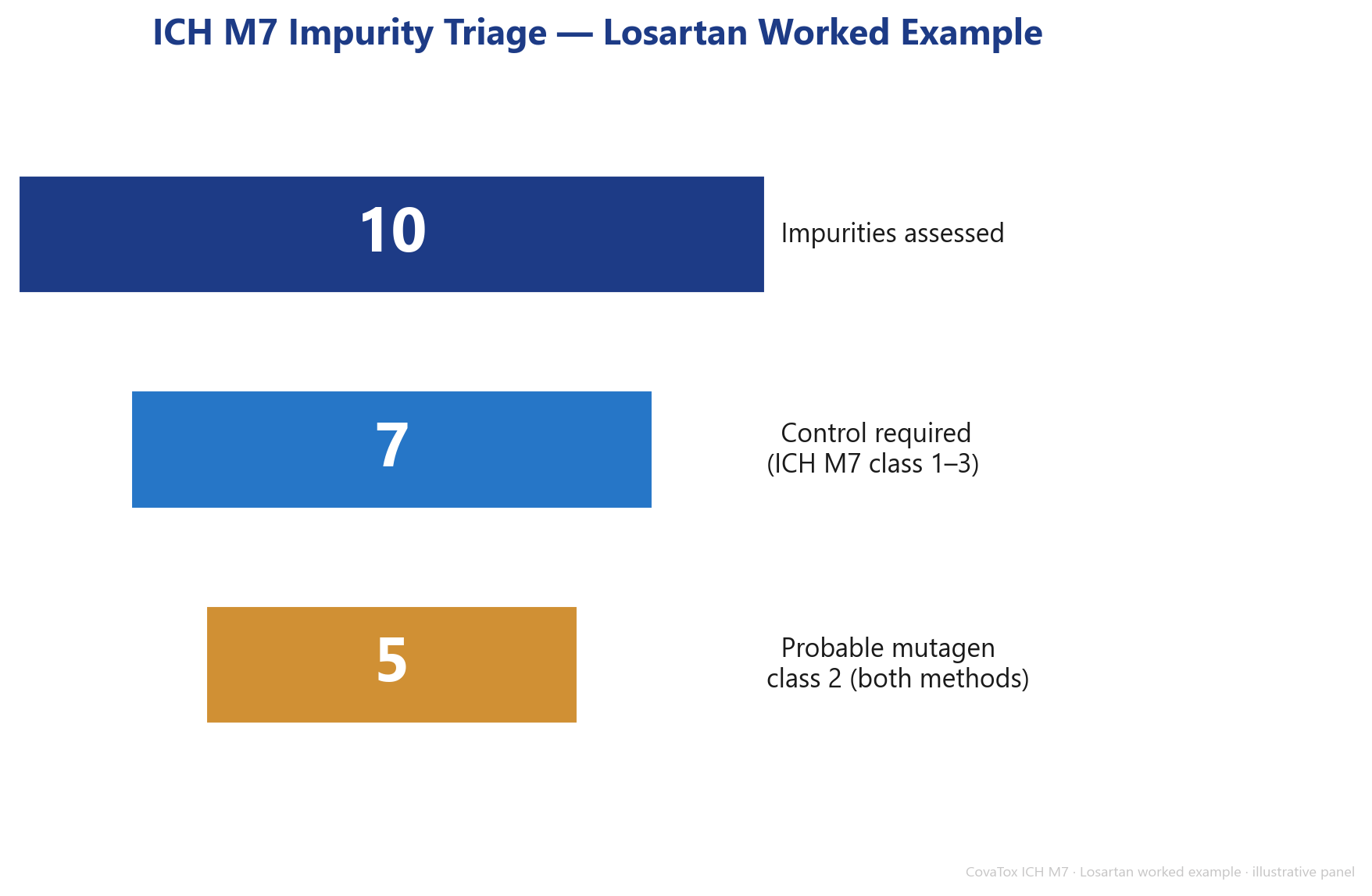
- On the Losartan worked example: 10 impurities assessed in seconds → 7 require control, of which 5 are probable mutagens (class 2) — including the well-known genotoxic azido impurity.
- The chemist focuses on the few flags instead of the entire list.
- Honest: (Q)SAR supports and documents the assessment — but does not replace expert review or, where required, a confirmatory Ames test.
A trace impurity can block a submission
Mutagenic impurities are one of the most sensitive topics in drug approval. A single DNA-reactive trace compound — generated during synthesis or by degradation — can delay or stop a submission. The sartan class has demonstrated this publicly over the past years: first nitrosamines, then azido impurities.
ICH M7 is the regulatory answer. The guideline requires every actual and potential impurity to be assessed for mutagenic potential — using two complementary (Q)SAR methods: one rule-based and one statistical. Done manually across dozens of synthesis intermediates and degradation products, this is slow, expert-dependent, and hard to document consistently.
We show on the active ingredient Losartan how CovaTox prepares this assessment in seconds. The usual honest disclaimer up front: this is an illustrative impurity profile, and the predictions support the assessment — they do not replace the final expert judgement.
What ICH M7 requires — and how CovaTox covers it
The core of ICH M7 is the requirement for two independent (Q)SAR approaches whose strengths complement each other. CovaTox runs both in a single call:
1. Rule-based — a structural-alert engine that recognizes DNA-reactive substructures via defined patterns (azides, alkyl halides, nitrosamines, reactive aldehydes). 2. Statistical — the deployed Ames mutagenicity model with a calibrated threshold, whose accuracy we report openly in the CovaTox benchmark.
The combination yields the ICH M7 class: both positive → class 2 (probable mutagen); one positive → class 3 (alerting / uncertain); both negative → class 5 (cleared). For classes 1 through 3, control at or below the TTC (Threshold of Toxicological Concern, 1.5 µg/day) applies.
The result: from 10 to the few that matter
For the ten assessed Losartan impurities, the triage picture is clear: 7 of 10 require control (class 1 through 3), of which 5 are probable mutagens (class 2, where both methods agree), and 3 are cleared (class 5). Instead of treating all ten the same, the chemist can focus on the five class-2 flags:
- Azido impurity (AZBT) — synthesis (azide/tetrazole route) · alert: azide · Ames stat. 0.89 (+) · class 2 · control required
- Bromomethyl-biphenyltetrazole — synthesis intermediate · alkyl halide · 0.83 (+) · class 2 · control required
- OTBN bromomethyl-cyanobiphenyl — synthesis intermediate · alkyl halide · 0.58 (+) · class 2 · control required
- N-nitroso impurity (NDMA-type) — synthesis (nitrosation risk) · nitrosamine · 0.72 (+) · class 2 · control required
- Losartan aldehyde — degradation (oxidation) · aldehyde · 0.84 (+) · class 2 · control required
- Losartan acid (EXP-3174) — degradation / metabolite · no alert · 0.72 (+) · class 3 · control required
- Desbutyl losartan — degradation · no alert · 0.58 (+) · class 3 · control required
- 2-Butylimidazole intermediate — synthesis intermediate · no alert · 0.17 (−) · class 5 · no control
- Biphenyl building block — synthesis intermediate · no alert · 0.07 (−) · class 5 · no control
- Valeric acid (residual) — synthesis side-product · no alert · 0.07 (−) · class 5 · no control
The azido impurity (AZBT) is, as expected, the headline class-2 flag — and it is confirmed by both methods: structural alert and statistical model agree.
In the agent workflow
This is what the step looks like in practice — a single call, both methods at once:
```text User: Run an ICH M7 mutagenicity assessment on my Losartan impurity list.
Agent: covatox_assess_ichm7_batch({ api_smiles: "...Losartan...", impurities: [ /* 10 SMILES */ ] }) -> 10 assessed | 7 control-required | 5 class 2 -> highest risk: azido impurity (AZBT), flagged by BOTH methods ```
The agent returns the classification as a structured table — directly documentation-ready, with the methodology trail that ICH M7 demands anyway.
The fine but decisive point: azide yes, tetrazole no
Sartans carry a tetrazole ring — a nitrogen-rich but in itself benign structure. Naive pattern matching easily goes astray here and alerts the whole scaffold. The craft of a robust structural alert is to hit the reactive azide of the AZBT impurity without falsely flagging the benign tetrazole ring of the active ingredient itself.
This is exactly the discrimination that makes automated screening usable in practice — otherwise the real warning drowns in false alarms.
Honestly placed
(Q)SAR predictions support and document the assessment but do not replace expert review or, where required, a confirmatory Ames test. Every positive (class 1 through 3) needs expert evaluation. The statistical model is deliberately conservative and can flag the parent scaffold: here it pushes two actually benign Losartan degradants (EXP-3174, desbutyl losartan) into class 3 — control at TTC pending review. That is the intended ICH M7 posture and exactly where the expert review resolves the call.
Try it yourself
You can run the same assessment for your own impurity list — both (Q)SAR methods in one call, classified according to ICH M7. On the free tier with 100 credits per week, no credit card. → See CovaSyn MCP
FAQ
What does ICH M7 require for impurity assessment?
ICH M7 requires every actual and potential impurity to be assessed for mutagenic potential — using two complementary (Q)SAR methods, one rule-based (structural alerts) and one statistical. Impurities in classes 1 through 3 must be controlled at or below the TTC (1.5 µg/day).
What does ICH M7 class 2 mean?
Class 2 designates an impurity with a structural alert for which insufficient mutagenicity data exists and which is treated as a probable mutagen. In automated assessment both (Q)SAR methods typically fire here; control or elimination is required.
Which (Q)SAR methods does ICH M7 require?
Two complementary ones: an expert rule-based method (structural alerts for DNA reactivity) and a statistical method (e.g. an Ames QSAR model). CovaTox runs both in one call and combines them into the ICH M7 class.
Does (Q)SAR replace the Ames test?
No. (Q)SAR prioritizes and documents, and can complement or prepare the Ames test in many cases under ICH M7. Positives require expert evaluation and, where necessary, experimental confirmation.
Why is the azido impurity relevant for sartans?
On the tetrazole synthesis route of sartans, genotoxic azido impurities can form. They are structurally alerting (organic azide) and classified as control-required under ICH M7.
Methodology and data
CovaTox ICH M7 dual assessment: rule-based structural-alert engine (SMARTS DNA reactivity) and the deployed statistical Ames model (calibrated threshold). Worked example: Losartan, illustrative 10-impurity profile (synthesis intermediates + degradation products). Combination rule: both positive → class 2; one positive → class 3; both negative → class 5; TTC 1.5 µg/day for class 1 through 3. The accuracy of the underlying Ames model is documented in the CovaTox benchmark.
CovaSyn MCP
Scientific tools in your AI workflow.
130+ functions for pharma, biotech and chemistry. Free tier instantly active.